Digital sales showroom for developers: renders to CRM
Turn a developer's existing renders into a clickable facade, 360 tour, indexable apartment pages and a CRM. New apartments are only a part of the market, so the developer's own surface has to work harder.
You commissioned renders for your new development, used them once in a brochure, and then they went quiet on a drive. Meanwhile the actual selling happens off-plan, before the building exists, scattered across a PDF floor plan, a portal listing and a stack of email threads. A digital sales showroom closes that gap. It takes the renders you already own and turns them into an always-on sales surface: a clickable facade, a 360 tour, per-apartment pages, and a CRM that catches every enquiry. In this article you'll learn what a digital sales showroom is, how renders plus 360 plus CRM fit on one platform, and how a visitor becomes a tracked lead.
Key Takeaways
- A digital sales showroom is one platform that turns a developer's existing renders into an interactive building orbit, a clickable facade with live availability, 360 tours and per-apartment pages, all feeding a built-in CRM.
- The same renders are reused, not rebought: they become orbit frames, the clickable-facade base image and the visual basis for 360 panoramas.
- New apartments are only a part of the market, and that share has been under pressure lately, so a developer's own surface matters more.
- A contact form becomes a lead, an email notification, a pipeline stage, a shareable offer page and sales analytics, with an embeddable widget for your own site.
What is a digital sales showroom for a developer?
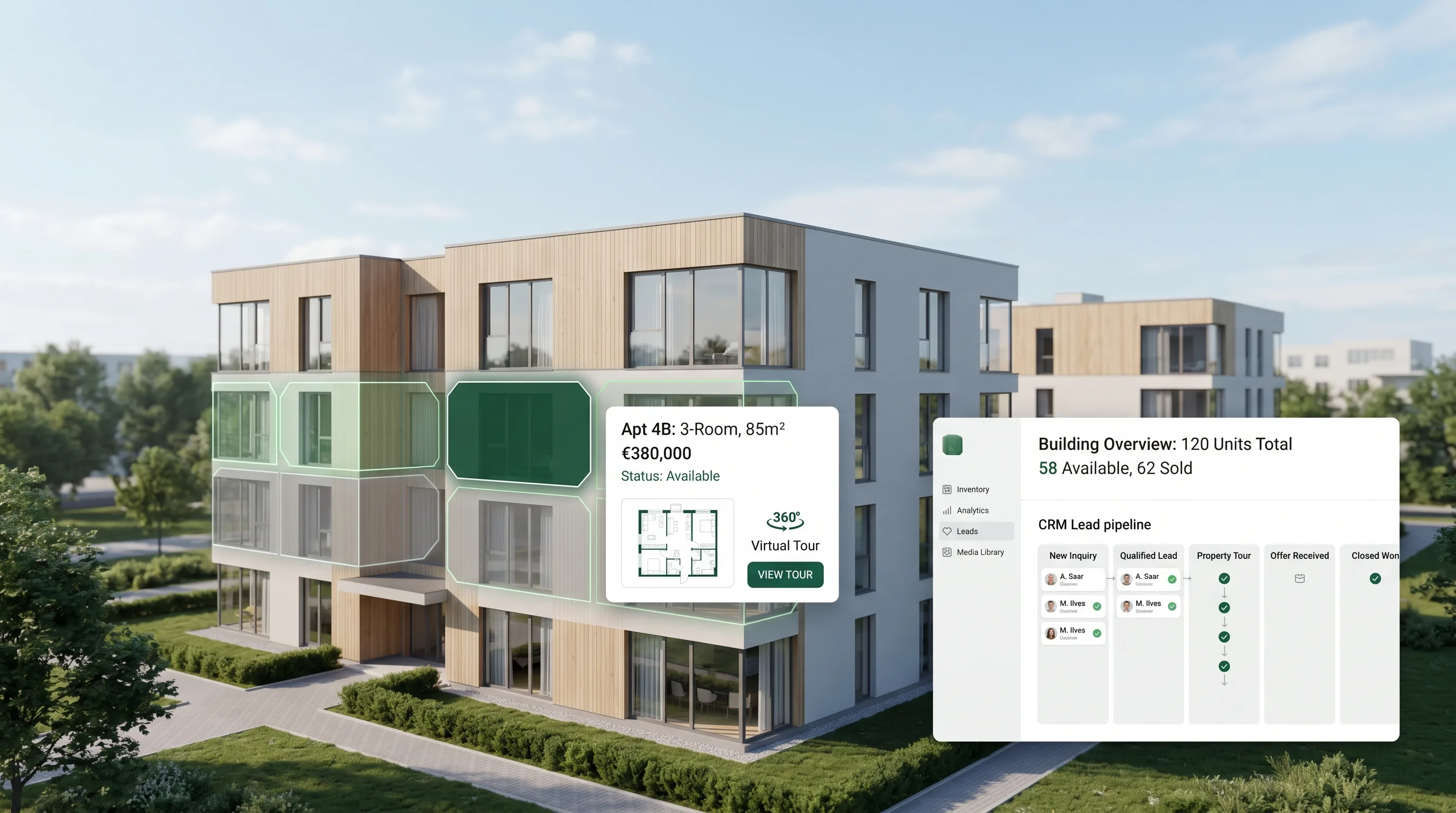
A digital sales showroom is a single platform that turns a developer's existing renders into an interactive sales surface and connects it to a CRM. It combines a rotatable building orbit, a clickable facade with live availability, 360 interior tours and per-apartment pages, then routes every enquiry into a pipeline. One system, not a stack of disconnected tools.
The phrase describes a shift, not just a viewer. A normal render package is a set of files delivered once. A digital sales presentation for a developer is the opposite: it stays live for the whole sales cycle and reacts to a buyer. They browse, open a home, walk inside virtually, and reach out, all in one place.
Proptech buyers increasingly want exactly this. Industry framing keeps describing one experience that connects visualisation, lead capture and analytics, rather than three tools stitched together by hand. That's the category a digital sales showroom sits in, but tied to your real renders instead of a generic template.
How do renders plus 360 plus CRM fit on one platform?
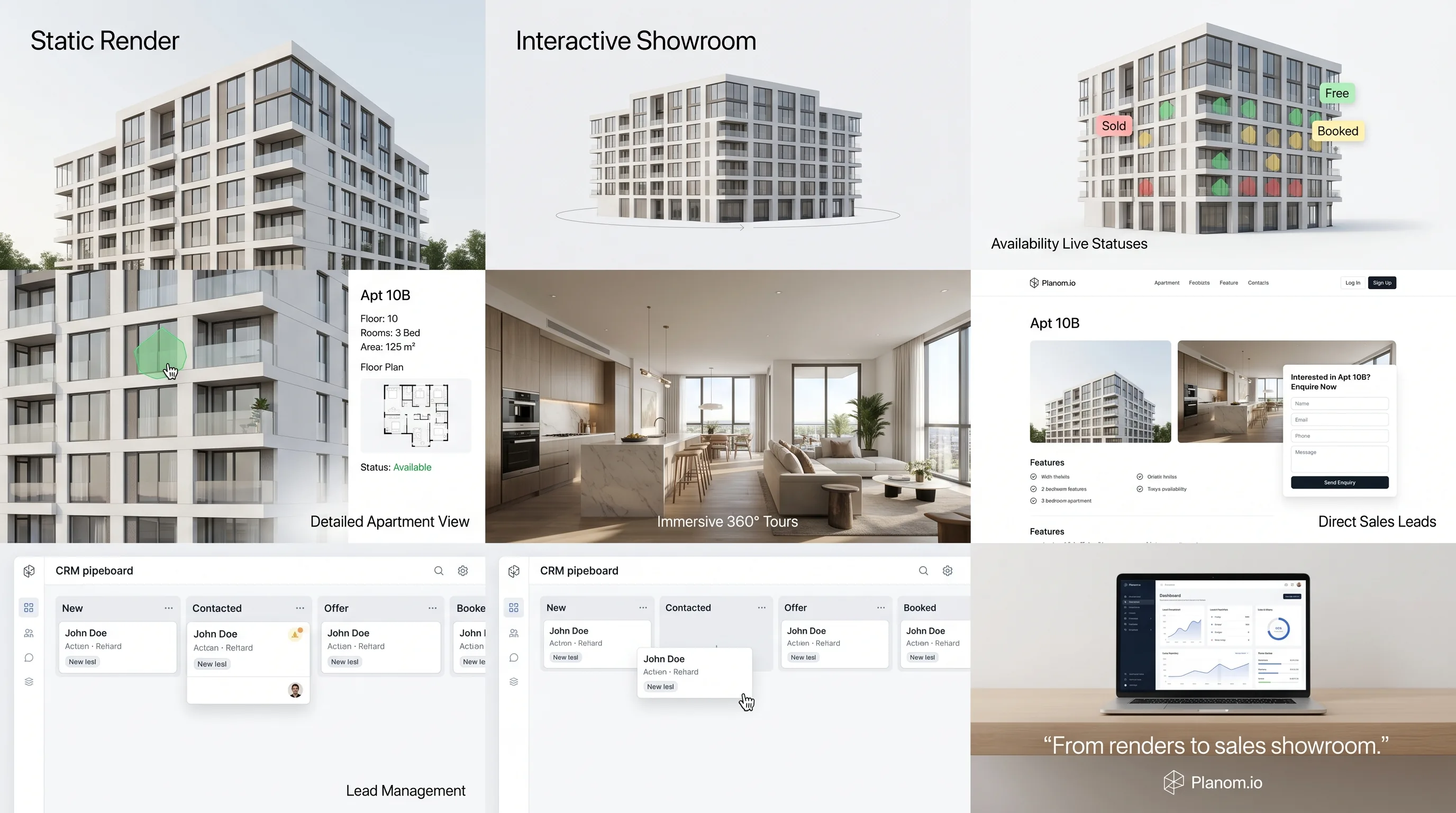
They fit because each piece reuses the asset before it. Your exterior renders become the orbit frames, the orbit carries the clickable facade, the facade opens 360 tours built from interior renders, and every tour and page ends in a contact form that feeds the CRM. Renders plus 360 plus CRM for developers, in one continuous flow.
This is the part that surprises developers most. The renders aren't a one-off deliverable that ends at handover: they become the spine of the whole sales surface. Nothing is reshot. The visualisations you commissioned simply get a second, permanent job.
The build maps onto assets you likely already hold.
From renders to a building orbit and clickable facade
Your exterior visualisations become a building orbit a visitor can rotate. On top of it sits the clickable facade, where each apartment is a polygon showing live status (free, booked, sold), floor, rooms, m2 and a floor plan. The deeper mechanics live in our guide to the clickable facade with apartment availability and plans.
From renders to 360 tours and apartment pages
Interior renders become the basis for walkable 360 panoramas, one tour per apartment type, plus a Google-indexable page per home. We cover selling on paper in the 360 virtual tour for off-plan sales, and where those visuals come from in our piece on real-estate renders and architectural visualisation in Estonia.
What a buyer can do inside the showroom
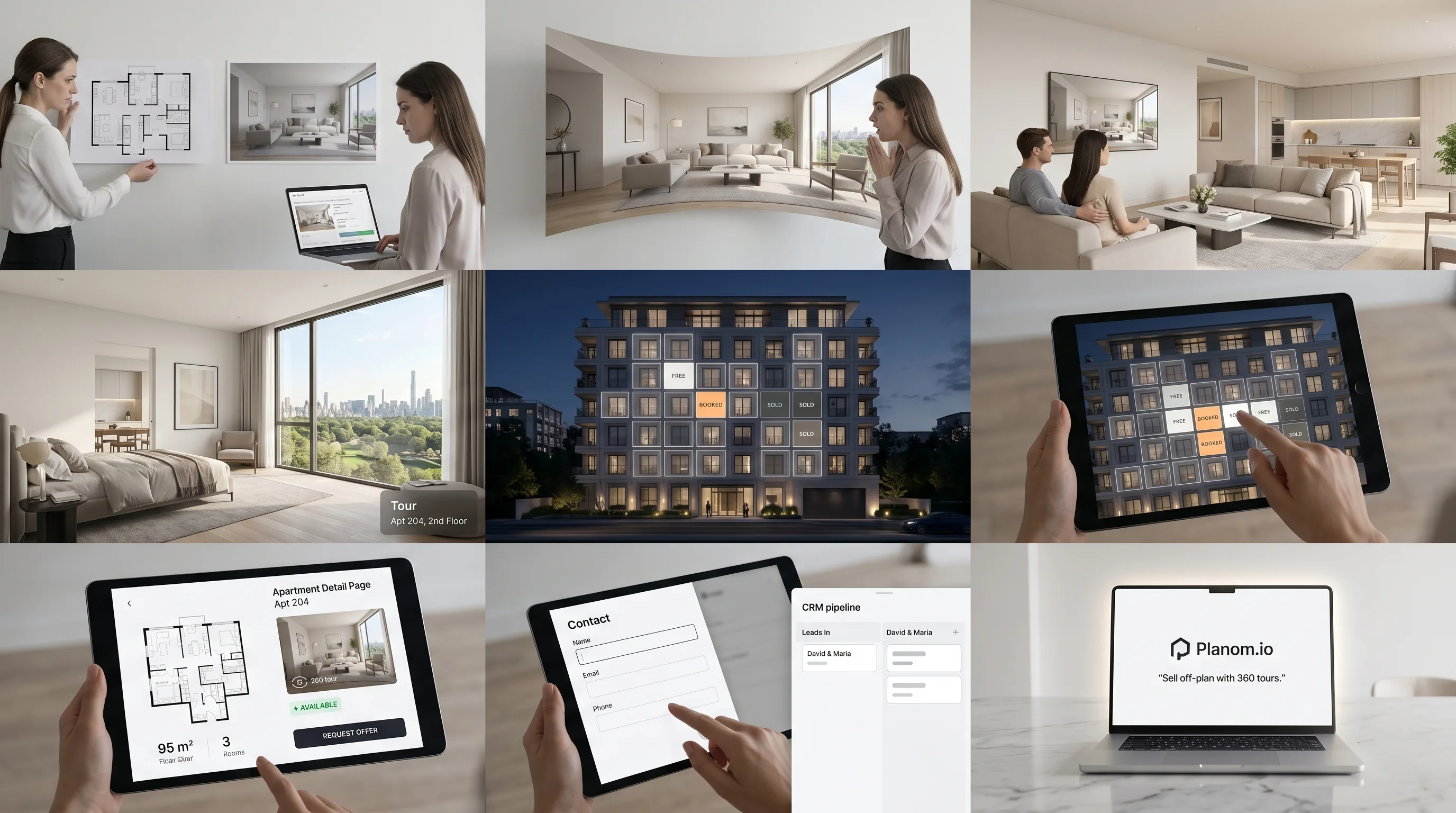
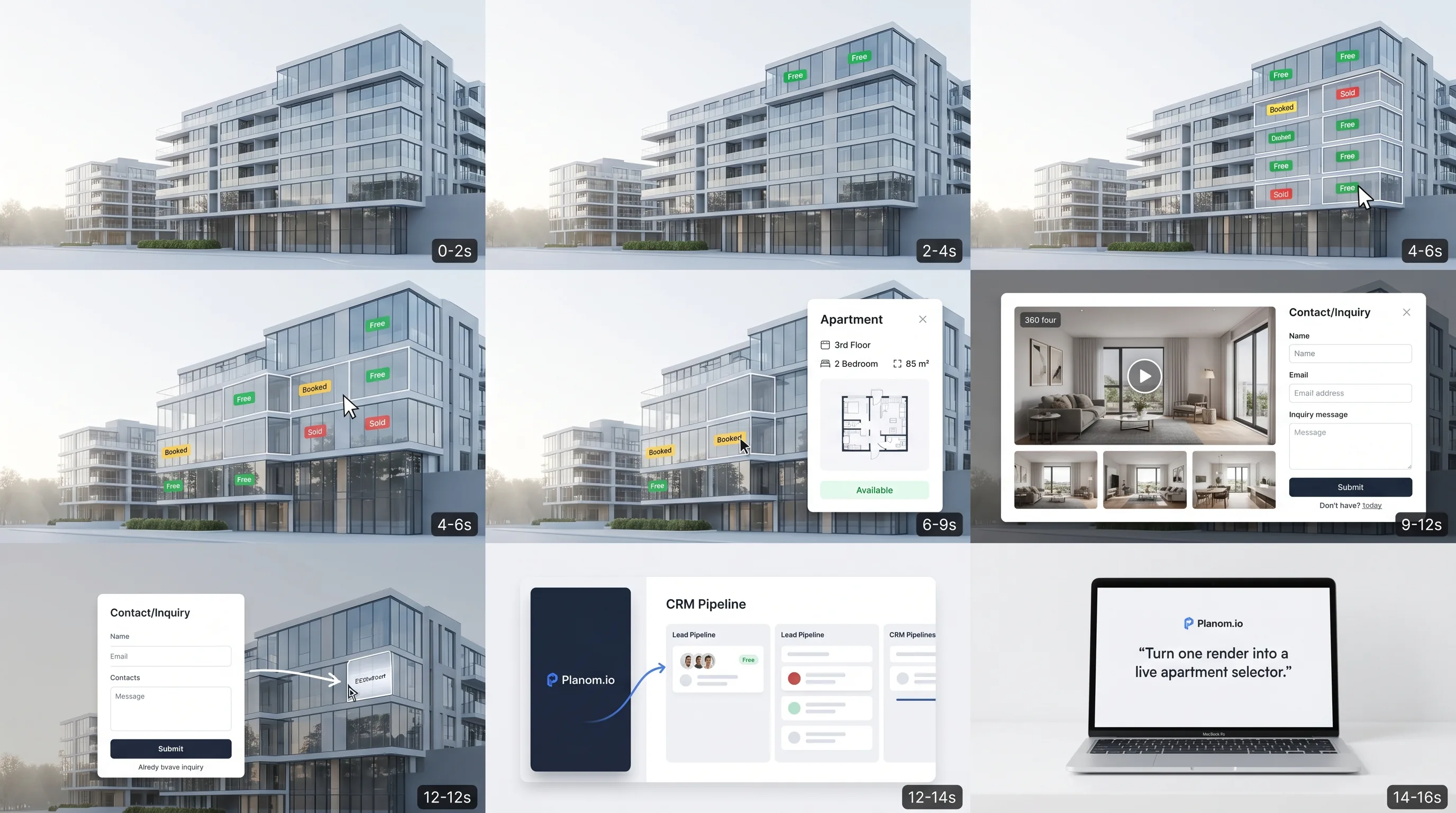
A buyer can rotate the building, click any apartment to see its status, floor, rooms, m2 and plan, step inside a 360 tour, open that home's own page, and send a contact message, without a single phone call. The showroom is a self-guided buyer journey, and notably, it leaves one thing off on purpose.
We deliberately keep the figure off the facade and the apartment pages. The showroom is a discovery and qualification surface, not a checkout. A buyer browses, finds a layout that fits their family, sees it's still free, and reaches out. That message is where the human conversation begins, and that's exactly where you want it.
So the field set per apartment stays focused:
- Status so nobody enquires about a sold home.
- Floor and orientation so a buyer can picture daily light.
- Rooms and m2 so they can match it to their needs.
- Floor plan so the layout reads at a glance.
- A contact form so interest turns into a tracked lead.
In our experience, this restraint raises enquiry quality. By the time someone fills the form, they've already self-qualified on layout, floor and availability, so your first reply lands with a buyer who genuinely fits the home.
A digital sales showroom lets a buyer rotate the building, click any apartment to see live status, floor, rooms, m2 and plan, walk a 360 tour and send a contact message. It shows availability and layout but deliberately omits the figure, so the showroom qualifies the buyer while keeping the sales conversation human.
How the showroom captures and manages leads
Every apartment page carries a contact form, and every submission becomes a lead in a pipeline the moment it arrives. Your team gets an email notification at once, and the lead moves through clear stages: new, contacted, offer, booked. Lead capture and CRM aren't bolted on later; they're the back half of the same platform.
The flow is one straight line. A buyer browses the facade, opens a free apartment, walks the 360 tour, and fills the form. That message lands as a lead tied to the apartments they actually looked at. From there you can send a shareable offer page, watch the buyer open it, and let sales analytics build over time, pipeline velocity, win rate, offer acceptance, all in one place.
Why does this matter? Because the recurring complaint with a tool stack is fragmentation. Visuals live in one system, lead capture in another, analytics in a third, and nothing talks. A new development sales platform with renders and a virtual tour solves that by keeping the visualisation and the CRM on the same rails.
In our experience, email campaigns close the loop nicely. You can mail your clients and past enquiries from the same platform that captured them, so a quiet apartment gets a nudge without exporting lists to a separate tool.
Why does a developer's own sales platform matter in Estonia?
Because in Estonia most new homes sell off-plan, the developer's own surface is often all a buyer can inspect. New apartments are only a part of the wider market, and that share has been under pressure lately, so a new build has to work harder to be discovered and understood.
Estonian buyers also search in three languages. The two dominant portals run in Estonian, Russian and English, and a developer relying on them competes inside a templated feed while losing the buyer relationship, the visual experience and the data. Owning your own showroom and an embeddable widget puts those back in your hands.
There's a trust dimension too. Estonian trade press frames buying off drawings alone as the risk of a põrsas kotis, a pig in a poke. A showroom with a 360 tour removes much of that fog: the buyer sees the home, the floor, the plan and that it's still free, all before a message. The native terms are worth pinning down: uusarendus (new development) and virtuaaltuur (virtual tour) in Estonian, novostroyka and virtualnyy tur in Russian.
For market context, home values have stayed broadly firm even as activity cools, a reminder that buyers are deliberate and want to understand a home fully before committing.
Because most new homes in Estonia sell off-plan, the developer's own digital sales showroom is frequently the only thing a buyer can inspect. New apartments are only a part of the market, and a recently softening share at that, so an always-on interactive surface with live availability does real work.
How is a showroom different from a one-off render package?
A render package is files: stills, a flythrough clip, sometimes a standalone tour, delivered once and then static. A digital sales showroom reuses those same files, adds live availability, 360 tours, indexable apartment pages and a CRM, and stays online for the whole sales cycle. One is a deliverable; the other is a working system.
The difference shows after handover. Renders alone carry no status, capture no enquiries, and go dormant in a folder. A showroom keeps working: it shows what's free today, opens apartment pages that can surface in search, and routes every interest into your pipeline. The assets you commissioned earn their keep instead of gathering dust.
Isn't that the real waste with a normal render budget? You pay for beautiful images, use them for one brochure, then let them sit. A showroom gives them a permanent role.
If you're still deciding who builds each piece, the pillar guide to who makes renders, 360 tours and the interactive apartment picker walks through the whole stack and how the roles fit together.
A one-off render package is files delivered once and then static, with no live status and no lead capture. A digital sales showroom reuses those same renders as an always-on surface with availability, 360 tours, indexable apartment pages and a built-in CRM, so the visualisation keeps converting buyers long after handover.
Frequently asked questions
What is a digital sales showroom for a developer?
A digital sales showroom is one platform that turns a developer's existing renders into an interactive building orbit, a clickable facade with live availability, 360 tours and per-apartment pages, all connected to a CRM. It replaces a stack of disconnected tools with a single surface that captures and manages leads.
Can I use my existing renders for the sales platform?
Yes. A new development sales platform with renders and a virtual tour is built directly on assets you already own. Exterior renders become the building orbit and clickable-facade base image, and interior renders become the basis for 360 panoramas. There's no reshoot, so dormant files become an always-on sales surface.
How does renders plus 360 plus CRM work on one platform?
The pieces chain together. Renders form the orbit and clickable facade, the facade opens 360 tours and apartment pages, and every page ends in a contact form. Each submission becomes a lead with an email notification and a pipeline stage (new, contacted, offer, booked), so visuals and lead handling stay in one place.
Can I add the showroom to my own website?
Yes. The interactive tour runs as an embeddable widget you drop onto your own site. An apartment click opens that home's page with its plan, specs, 360 hero and contact form. The buyer relationship and the lead data stay with you, not with a third-party portal.
Does the apartment page show the figure?
No. The showroom deliberately omits the figure from the facade and the apartment pages. Each home shows availability status, floor, rooms, m2 and its floor plan, plus a contact form. The surface is built to qualify a buyer and start a direct conversation, not to act as a checkout.
Building a new development and weighing how to present it online? Tell us about your project and we'll show you what a digital sales showroom built from your renders could look like.
About the author: Andres Tamm writes about real-estate sales and visualisation for new-development teams in Estonia, with first-hand experience turning developers' renders into interactive, lead-capturing sales surfaces.
See your project as a live map.
Send us your drawings. We render it - and make it sell.