Architectural visualization and real estate renders in Estonia: types and how to choose
A developer's guide to real estate renders in Estonia: render types, choosing a studio, and reusing renders as an interactive sales surface.
You're selling a new development long before the building exists, and renders are the only thing a buyer can actually see. So the visualisation work isn't decoration, it's the product on the page. Most developers in Estonia commission strong exterior and interior images, maybe a flythrough, and then watch those files go quiet inside a brochure. This guide explains the main types of real estate renders in Estonia, how to choose an architectural rendering studio, and the part almost everyone misses: renders alone don't sell. We'll show how the same images become an always-on interactive sales surface with availability and lead capture, not just pretty pictures.
Key Takeaways
- The main render types are exterior stills, interior stills, aerial views and flythrough animation; each serves a different stage of the sale.
- Estonia's housing market stays competitive, so a new build must work harder to be discovered and understood.
- New apartments are only a part of the wider market, which makes your own marketing surface matter more.
- Choose a studio on photoreal quality, format range and turnaround, then plan how the files stay useful after delivery.
- Renders become an interactive orbit, a clickable facade and 360 tours instead of dormant files.
The four main types of real estate renders in Estonia
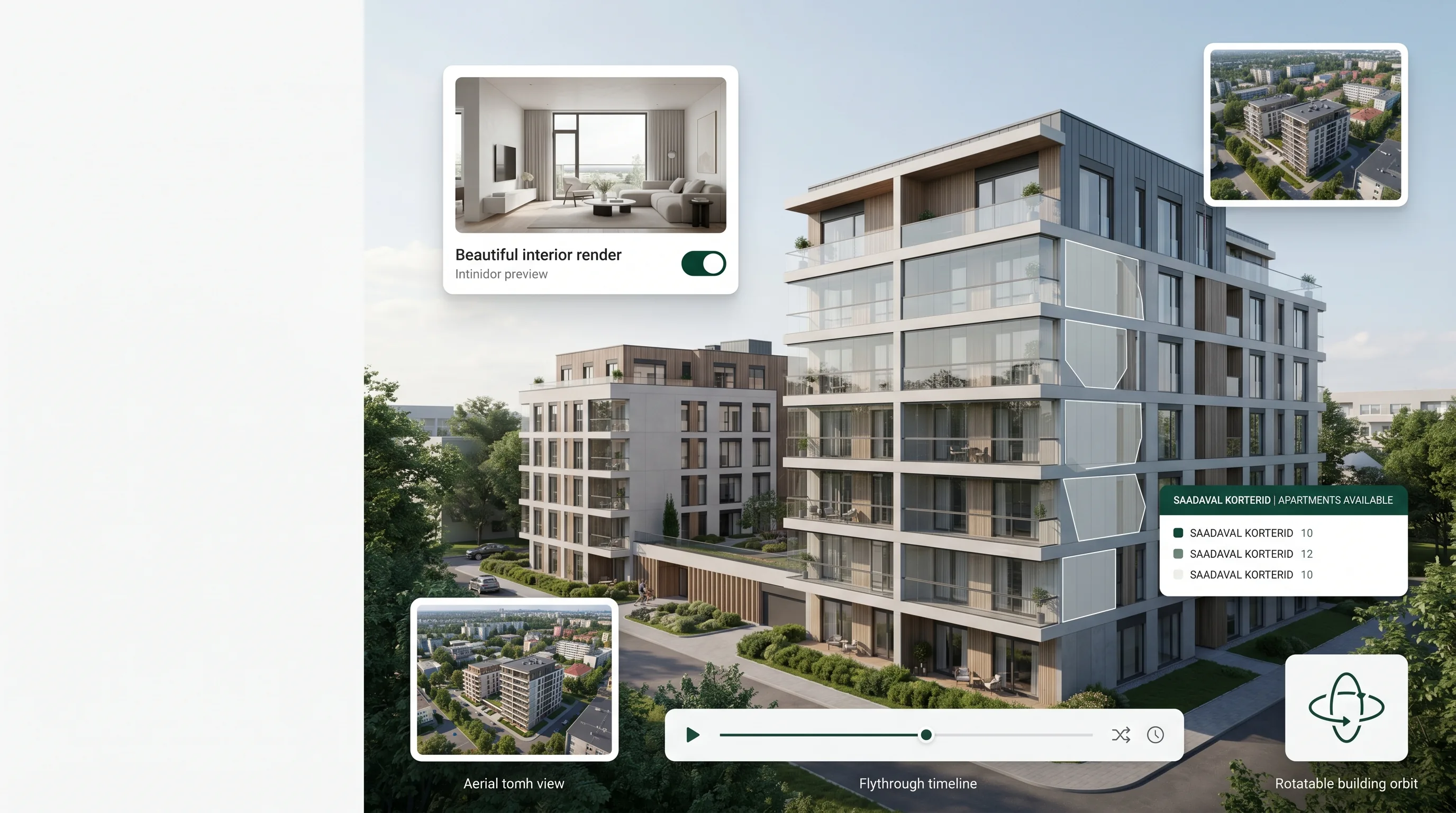
Real estate renders in Estonia fall into four working types: exterior stills, interior stills, aerial or bird's-eye views, and flythrough animation. Each answers a different buyer question. Exteriors sell the building and the street, interiors sell the home itself, aerials sell location, and animation ties them together into one moving sequence. Most projects use a mix.
Exterior renders show the facade, entrances and how the building sits in its surroundings. Interior renders place a buyer inside a future apartment, with light, materials and finishes. Aerial views answer the location question that floor plans never can. Flythrough animation, a short rendered video, walks the eye from the street through the courtyard and sometimes indoors.
In our experience working with Estonian new-development teams, the most common gap isn't quality. It's coverage. A developer buys gorgeous interiors of one show apartment but nothing for the other layouts, so most units sell on a flat plan alone. Plan your render brief around every apartment type you actually need to sell, not just the hero unit.
Architectural visualisation in Estonia centres on four render types: exterior stills, interior stills, aerial views and flythrough animation. Each maps to a buyer question, building, home, location and the full journey. Because new apartments are only a part of the wider market, coverage of every layout matters as much as image quality.
Why does architectural visualization in Estonia matter for off-plan sales?
Architectural visualization in Estonia matters because new builds are sold from drawings and renders long before completion, while much of the demand sits in existing stock. The housing market stays competitive. In that setting, your visuals are the whole first impression.
Off-plan selling in Estonia, ET uusarendus, RU novostroyka, means marketing a home that doesn't physically exist. Buyers commit based on plans, renders and a sense of trust. Estonian trade press frames good 3D and VR as removing the "pig in a poke" risk, ET põrsas kotis, of buying off drawings alone. That trust gap is exactly what strong visualisation closes.
There's a market pressure too. Buyer demand can tilt toward existing homes rather than new builds, and when that happens the buyers who do choose a new development need to understand and trust the project faster. Better visualisation isn't a luxury, it's how you compete for their attention.
How do you choose an architectural rendering studio in Estonia?
Choosing an architectural rendering studio in Estonia comes down to four things: photoreal quality, the format range they cover, turnaround speed, and how usable the files stay afterward. There are strong visualisation studios in Estonia delivering exterior and interior stills, aerials and flythrough animation. The harder question is what happens to those assets after handover.
Check the format range and the brief
Make sure one studio can cover the formats you need: stills, aerials and flythrough animation, ideally with 360 panoramas too. A multi-format package keeps your visual language consistent across the portal listing, your website and approvals. Ask for examples of new development 3D renders at the scale of your project, a residential complex, not a single villa.
Look at quality, revisions and timing
Photoreal quality is the obvious test, but revision rounds and timing decide whether the project hits its launch. Ask how many revisions are included and how lighting, materials and landscaping are handled. In our experience, the biggest delays come from vague briefs, not slow studios. Lock your materials, finishes and apartment list before the first render.
Plan for what happens after delivery
Here's the question almost no one asks the studio: what do these files do once they're delivered? A traditional studio hands over images and a clip, then stops. The assets get used once for a brochure or a portal listing and go dormant. That's the real waste, files that work once and then sleep. Plan the second life of every render before you commission it.
Renders versus an interactive sales surface
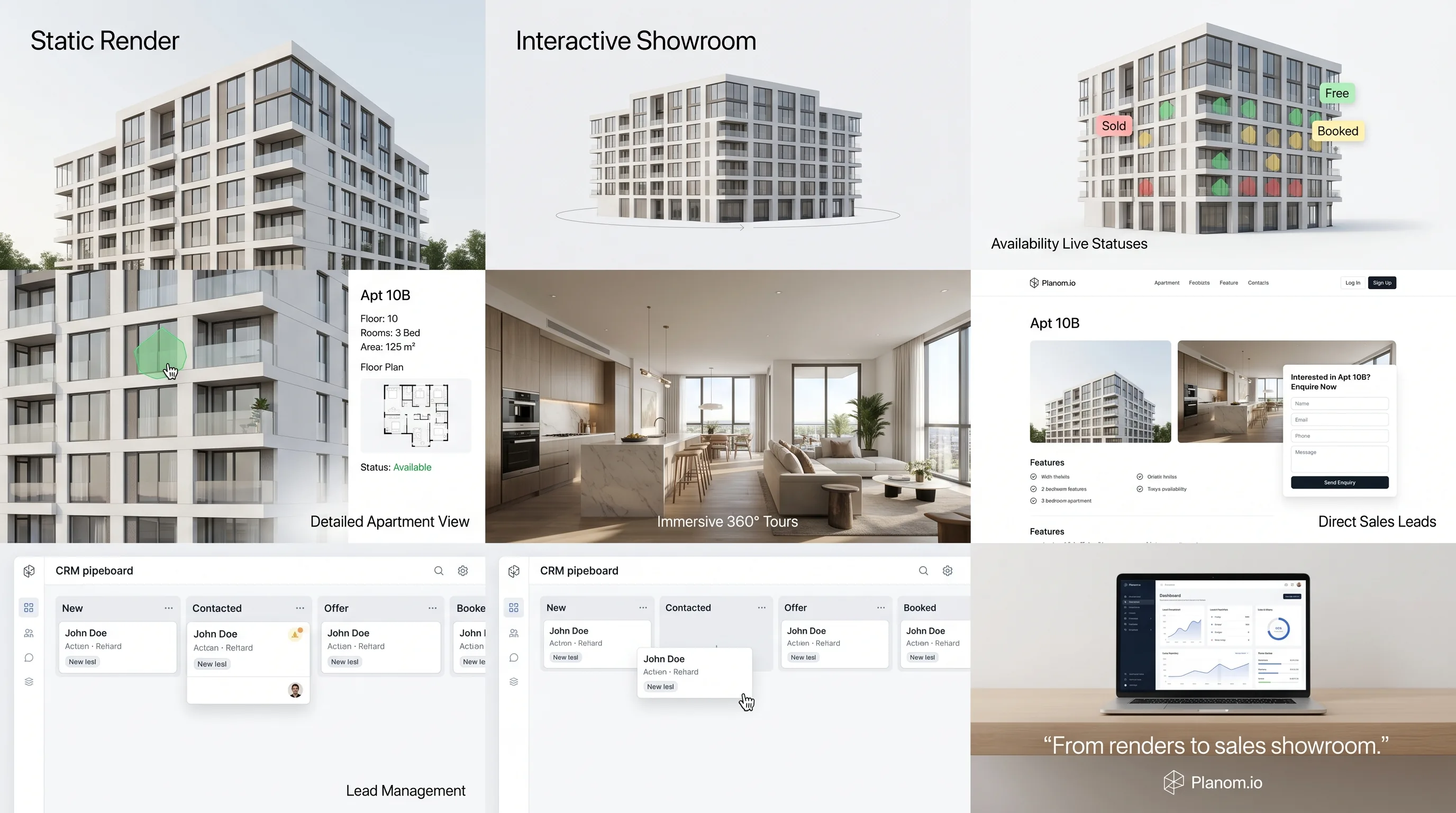
The difference is simple: a render is a file, an interactive sales surface is a system. A render studio delivers static images or a flythrough clip and stops there. An interactive surface turns those same images into a clickable facade with live availability, 360 tours and built-in lead capture, working around the clock instead of sitting in a PDF.
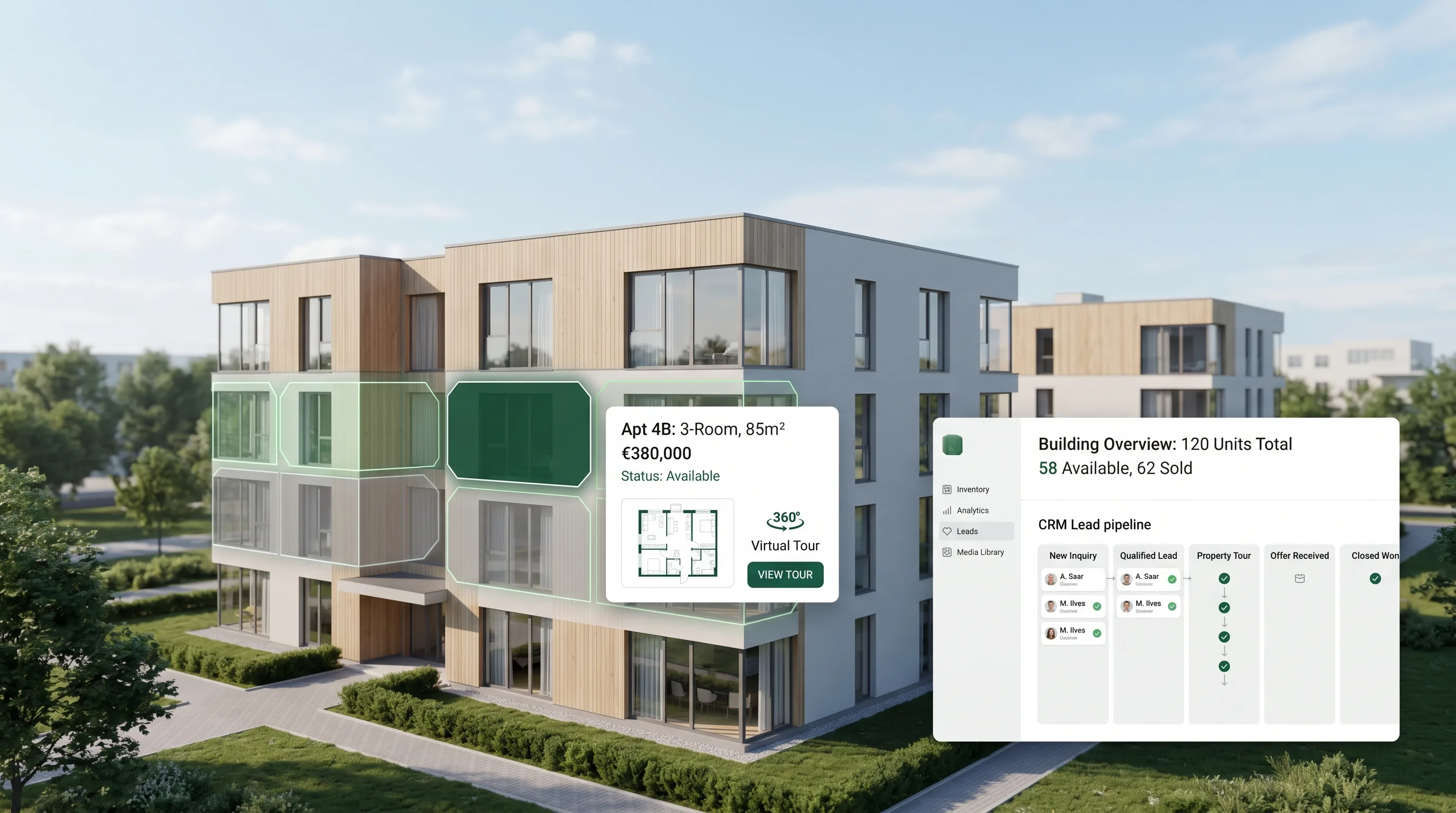
3D visualization for developers usually ends at the deliverable. But the same renders can do far more. The exterior render becomes an orbit a buyer can rotate. The building image becomes the base for a clickable facade, where every apartment is a polygon. The interior renders become the visual basis for 360 panoramas. Nothing new gets commissioned, the inputs are what you already paid for.
Does a beautiful render capture a single lead on its own? Rarely. It informs, it impresses, but it doesn't ask for contact details or show whether unit 34 is still free. That work happens on the interactive layer. We go deeper on that layer in our guide to a clickable facade with apartment availability and plans, and on the immersive side in 360 virtual tours for new development off-plan sales.
A render studio delivers static images or a flythrough clip, then stops. An interactive sales surface turns those same files into an orbit, a clickable facade with live status, and 360 panoramas, the renders are reused, not replaced. Industry framing increasingly favours one connected experience over a stack of disconnected tools, the recurring proptech buyer complaint being fragmentation.
How do renders become an interactive orbit, clickable facade and 360 tour?
Your existing renders become three connected things: a rotatable exterior orbit, a clickable facade where each apartment is a polygon, and per-apartment 360 panoramas. The exterior images supply the orbit frames. The building view becomes the facade base. The interior renders feed the panoramas. The same files, working as one surface.
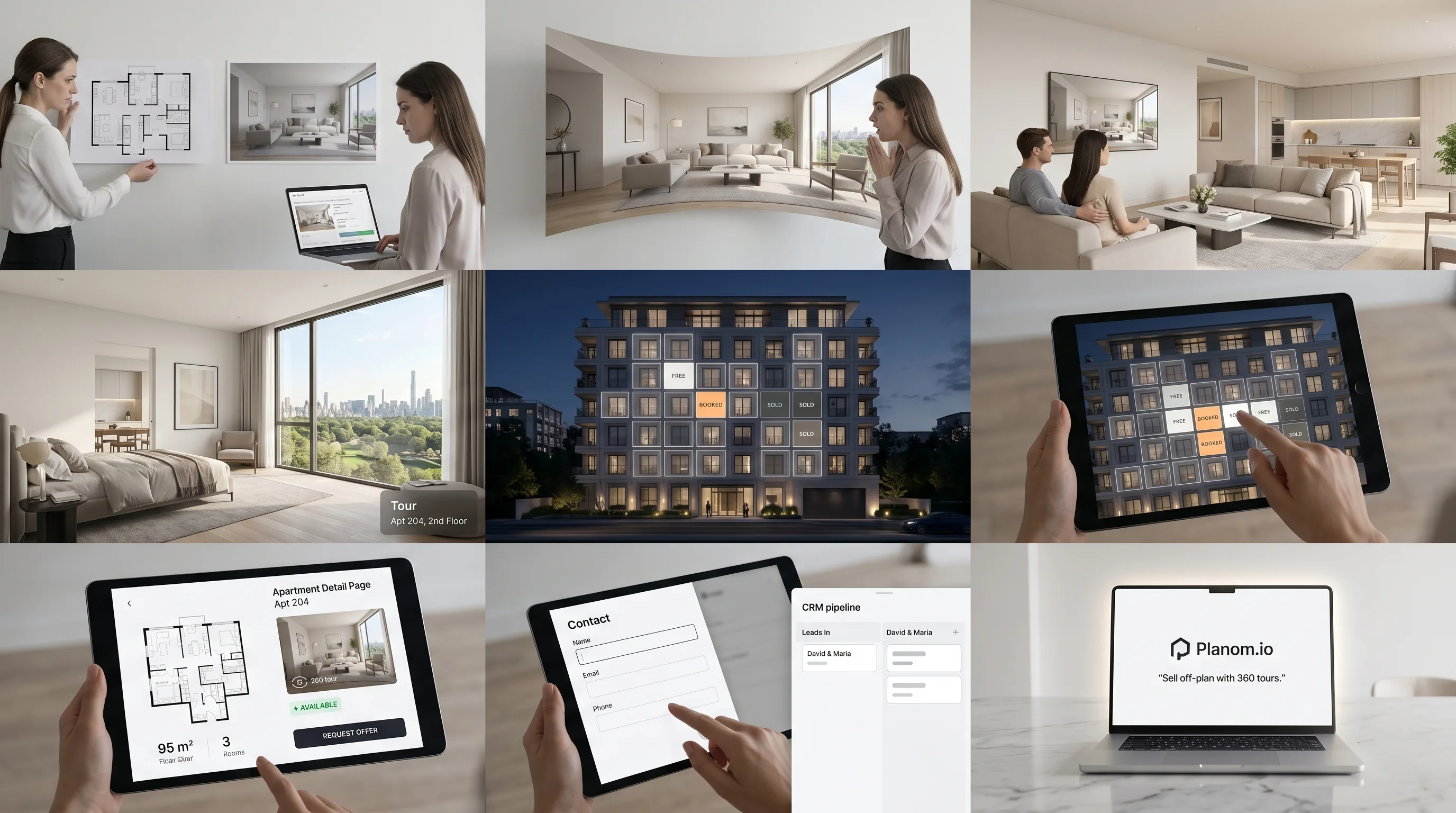
On the clickable facade, ET klikitav fassaad, RU klikabelnyy fasad, a buyer picks a building, picks a floor and clicks an apartment. The polygon shows floor, room count, m2, the layout plan and live status: free, booked or sold. The buyer's next step is a contact form, not a checkout, so the conversation stays with your sales team rather than ending on a public page.
Then each apartment gets its own shareable, Google-indexable page: a 360 hero, the floor plan, specs and a contact form. This matters for discovery. Estonian buyers search heavily on portals that run in Estonian, Russian and English, so your apartment pages should be legible and findable in all three. An embeddable widget drops the whole interactive tour onto your own website, where an apartment click opens that apartment's page. For how the whole surface fits together end to end, see our guide to a digital sales showroom built on renders, 360 tours and a CRM.
Why pair renders with lead capture and a CRM?
Renders generate interest, but interest leaks without somewhere to land. Pairing visuals with lead capture and a CRM means a contact form becomes a tracked lead, your team gets notified, and the deal moves through a pipeline instead of an inbox. Industry guidance increasingly favours one experience that connects visualisation, lead capture and analytics over scattered tools.
The flow is direct. A buyer browses the orbit, clicks an apartment, reads the page and submits a contact form. That form becomes a lead with an email notification to your team, then moves through stages: new, contacted, offer, booked. Offers get shareable buyer pages. Sales analytics show what's working. It's one platform, not five.
Why does this beat keeping renders and CRM in separate tools? Because attribution survives. You can see which apartment a lead viewed before they wrote in, so your visualisation work connects to actual deals instead of vanishing after a brochure. For the connected sales side, see our guide to a digital sales showroom built on renders, 360 tours and a CRM.
Frequently asked questions
What types of real estate renders do developers in Estonia need?
Most new-development projects need four render types: exterior stills, interior stills, aerial views and flythrough animation. Exteriors sell the building, interiors sell the home, aerials sell location, and animation connects them. Plan coverage for every apartment type you must sell, not only one show unit, so each layout has its own visuals.
What value do renders keep after the launch brochure is done?
The lasting value comes from reuse, not from a single brochure appearance. A render that powers an interactive orbit, a clickable facade and a 360 tour keeps working for months. In our experience, the visuals that earn the most are the ones planned as an always-on sales surface from the very first brief, not as one-off marketing files.
Can you sell off-plan apartments with renders and a 360 tour in Estonia?
Yes. Off-plan selling, ET uusarendus, is how most Estonian new builds are marketed, from drawings, renders and floor plans, with availability tracked per unit as free, booked or sold. Renders plus a walkable 360 virtual tour let buyers understand a home before construction, which Estonian trade press frames as removing the "pig in a poke" risk of buying blind.
How is an interactive apartment selector different from a render?
A render is a static image you look at. An interactive apartment selector, or clickable facade, is a building image where each apartment is a clickable polygon showing floor, room count, m2, the layout plan and live status. The render is the picture, the selector is the working sales surface that captures a buyer's contact details.
Do I need new renders to build an interactive tour?
No. The point is reuse. Your existing exterior renders supply the orbit frames, the building view becomes the clickable facade base, and your interior renders feed the 360 panoramas. The inputs are the files you already commissioned, so nothing new gets ordered just to make the tour work.
About the author: Andres Tamm writes about real-estate sales and visualisation for new-development teams in Estonia, with first-hand experience turning developers' renders into interactive, lead-capturing sales surfaces.
Renders are the start, not the finish. If you'd like to see how your existing visuals could become an interactive sales surface, tell us about your project.
See your project as a live map.
Send us your drawings. We render it - and make it sell.